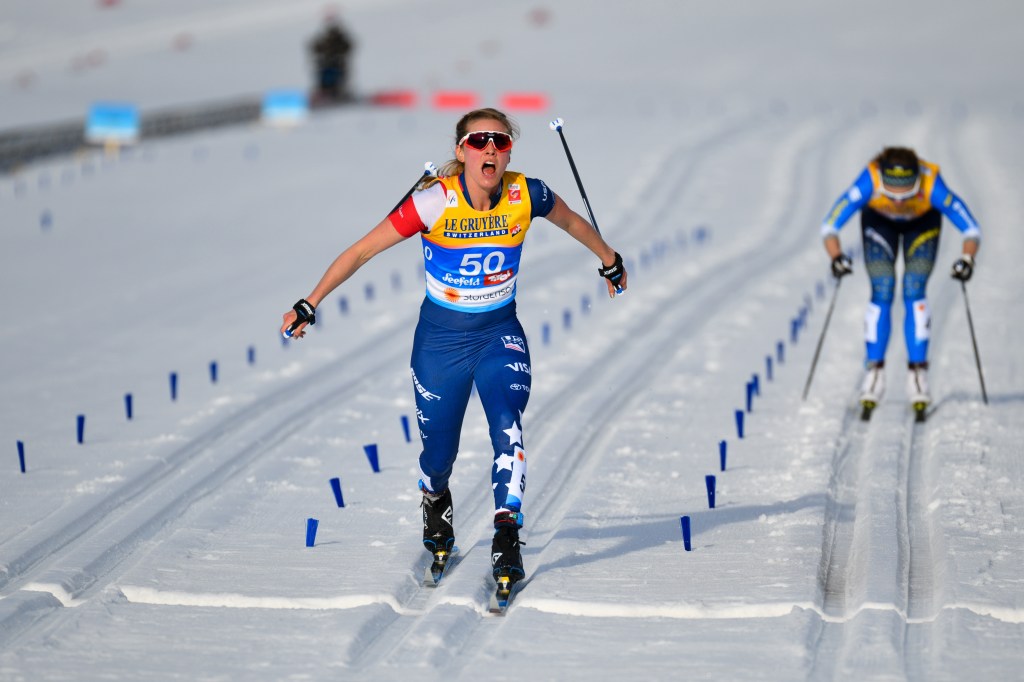
The Tour de Ski is now over and we have two new events to go through. But first things first, congratulations to Jessie Diggins and Johannes Høsflot Klæbo, the overall winners of this year’s Tour de Ski. Diggins claimed her third overall victory and Klæbo won a record-breaking fifth title, surpassing Dario Cologna’s record of four. Let’s take a closer look, how the two last events unfolded.
by Sami
The last two races were held in Val di Fiemme. First of the two events was a classic style sprint, and it was raced on the same track that will be used in the Olympic Games later this year. The track itself was a bit different than the year before. It was changed to meet the standards that an Olympic event should match. In Val di Fiemme, the sprint track has a long downhill section at the finish and because of this, many times in the World Cup we see a bit of “standing” on the top of the last hill that’s leading to the downhill. By standing, I mean that the pack of skiers slow down and wait to see who takes the bait and goes first. Then, with the benefit of the draft that the first skier creates, others will catch up and at the end finish before the one, who was first to take the downhill. By changing the track a bit, the officials try to change the way it behaves. They have added a new uphill section, so there are new opportunities to strike and build a gap against other competitors. The track is also a bit longer now, with finishing times being almost a full minute longer than before.
So, who mastered the new sprint track? – Sprint Classic (3 January)
In the women’s race, there was drama even before the race had started. Norway’s Kristine Stavås Skistad had fallen ill and would not start the race. A strong winner candidate was out of the race and this presented a new opportunity for those who were still competing.
Straight away, Finland’s Jasmi Joensuu was the one who seized this opportunity. Joensuu was fastest in qualification, carried that momentum through the heats, and took the first World Cup victory of her career. Second place went to a skier who won in Val di Fiemme last year: Switzerland’s Nadine Fähndrich, who also had a strong day, adding another podium to her record. Third in the race was the current leader of the World Sprint Cup, Johanna Hagström who performed strongly, despite feeling unwell during the heats.
Tour overall leader Jessie Diggins almost made it to the final, finishing seventh.
| Women | Skier | Country | Time |
| 1. | Jasmi Joensuu | Finland | 3:45.75 |
| 2. | Nadine Fähndrich | Switzerland | +0.44s |
| 3. | Johanna Hagström | Sweden | +1.94s |
| 4. | Maja Dahlqvist | Sweden | +5.03s |
| 5. | Johanna Matintalo | Finland | +6.42s |
| 6. | Anja Weber | Switzerland | +13.63s |
Full Results: HERE
In the men’s race, we followed the usual pattern. Johannes Høsflot Klæbo won qualification and after that went to win every heat and the final adding another victory to his name. During the last uphill section of the race, Klæbo made his attack – ran up the hill and never looked back, as per usual. Behind him, France’s Jules Chappaz took his first podium of the season. During the semi finals, Chappaz was looking strong and delivered a quiet Klæbo-like run up the hill. Podium must have tasted great after that. In the third position, we have another first-timer. Sweden’s young Anton Grahn just barely lost to Chappaz, and made his way to the podium. With not many World Cup starts under his belt, he can be happy with that result.
| Men | Skier | Country | Time |
| 1. | Johannes Høsflot Klæbo | Norway | 3:21.28 |
| 2. | Jules Chappaz | France | +3.11 |
| 3. | Anton Grahn | Sweden | +3.14 |
| 4. | Angar Evensen | Norway | +3.63 |
| 5. | Lars Heggen | Norway | +4.26 |
| 6. | Jan Stölben | Germany | +11.23 |
Full Results: HERE
And with that, heading to the final event – the 10 km skate race up to the Alpe Cermis – the same names were still in the lead: Jessie Diggins and Johannes Høsflot Klæbo.
Final event: Climb to the Alpe Cermis – 10 km Mass Start Free (4 January)
Climb to the Alpe Cermis… that one unusual event in the World Cup that you have maybe heard of even if you don’t even follow cross-country skiing This event is a 10 km skate mass start, where first the skiers travel around 6.5km to the bottom of the mountain and then they start climbing up the hill. Race itself is brutal, a couple years ago there was an athlete who passed out at the goal due to exhaustion.
This year’s race was won by Norway’s Karoline Simpson-Larsen. Simpson-Larsen has really taken a step up on her performance, earlier this season she won at Davos, and now she did it again. Second on the finish line was Jessie Diggins. During the climb, it looked like Jessie would finish outside the podium, but she did a stellar final spurt just before the finish line to finish second. Nice way for her to end this Tour. Also, for the moment it looks like this was the last climb to Alpe Cermis that she will race, since she has openly stated that after this season she will retire. Heidi Weng from Norway finished third, and by doing so climbed nicely in the overall standings of the Tour de Ski.
| Women | Skier | Country | Time | Gap |
| 1. | Karoline Simpson-Larsen | Norway | 37:05.3 | |
| 2. | Jessie Diggins | United States | 37:14.1 | +8.8s |
| 3. | Heidi Weng | Norway | 37:19.7 | +14.4s |
| 4. | Teresa Stadlober | Austria | 37:22.8 | +17.5s |
| 5. | Ebba Andersson | Sweden | 37:27.2 | +21.9s |
Full Results: Here
Mattis Stenshagen from Norway’s National B Team is showing up when it counts. He endured the pain and took victory from the hands of France’s Jules Lapierre. Only 6.6 seconds between these two athletes. At one point, it looked like Lapierre would take his second win at the Alpe Cermis (first being in 2024), but Stenshagen overtook him and never looked back.
Behind them, we almost witnessed a surprising podium for Savelii Korostelev, a young Russian skier who is racing as a neutral athlete under the FIS flag, but Norway’s Emil Iversen snatched the podium away, denying Korostelev his first podium finish.
| MEN | Skier | Country | Time | Gap |
| 1. | Mattis Stenshagen | Norway | 33:25.3 | |
| 2. | Jules Lapierre | France | 33:32.1 | +6.6s |
| 3. | Emil Iversen | Norway | 33:45.9 | +20.4s |
| 4. | Savelii Korostelev | AIN | 33:50.9 | +25.4s |
| 5. | Harald Østberg Amundsen | Norway | 33:55.6 | +30.1s |
Full results: Here
Tour de Ski is over, how did it go?
So, like mentioned above. Women’s Tour overall went to Jessie Diggins and men’s to Johannes Høsflot Klæbo. What more can be said, they were just on a different level to other competitors. Almost every event they were in the right place and just kept either extending or managing their lead by making no mistakes.
In the Tour de Ski, there are also overall scoring tables for the best climber and for the best sprint racer. Points for these categories are calculated by doing good times on the climbing sections of the races and for the sprint classification, doing well in sprints.
Overall winners of each category:
| Tour | Sprint | Climber | |
| Women | Jessie Diggins | Maja Dahlqvist | Teresa Stadlober |
| Men | Johannes Høsflot Klæbo | Johannes Høsflot Klæbo | Mattis Stenshagen |
Overall finishing list for the Tour de Ski can be seen here:
Women:
Men:
While the races on this year’s Tour de Ski were interesting to watch, it must be noted that the events were much “lighter” than before. Quite a bit of criticism has been given to the Tour, it didn’t challenge the skiers as much as some of them would have liked. This might be because of the upcoming Winter Olympics – FIS has played it safe by not doing events so hard. This is mainly because if the Tour was too demanding for the athletes during the Olympic season, some athletes might have preferred not to join and that would be bad for the sport.
Next stop, Oberhof!
Now the World Cup takes a short break and will continue later this month. We’ll return with freestyle sprints on 17 January followed by a classic 10 km interval start race on 18 January. Until then, see you!
Header photo credit: FIS/ActionPress/Arnd Wiegmann

Leave a comment