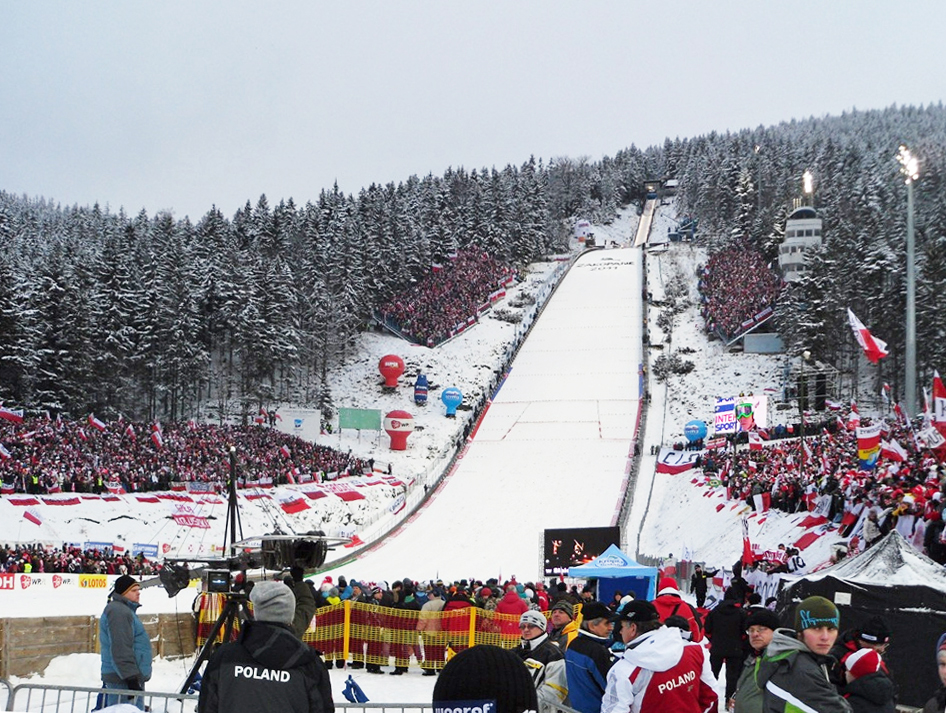
Anže Lanišek won the individual competition in Zakopane on Sunday, while the Austrian duo of Jan Hörl and Stephan Embacher came out on top in the Saturday’s Super Team event. Kamil Stoch said goodbye to his Polish fans and Yevhen Marusiak surprised everyone in Saturday’s qualification round.
by Maciej Jackiewicz
Saturday
Qualification round
In contrast to a usual World Cup weekend, the training and qualification rounds did not take place on Friday, but on Saturday with the goal of letting the athletes rest after an exhausting Four Hills Tournament. The qualification was supposed to begin with the jump of Nurshat Tursunzhanov, but the Kazakh was not permitted to start due to irregularities with his suit. Despite this, the first jumps of the qualification were extraordinary – Hektor Kapustík of Slovakia jumped 130.5 metres to show that he can fight for points on Sunday, and then Yevhen Marusiak from Ukraine achieved mind-blowing 145 metres, just two metres shorter than the hill record set by Yukiya Sato. With that, it came as no surprise that the jury lowered the gate from gate 14 to gate 13.
In the next minutes no one could get close to Marusiak’s result. There were good jumps, from the likes of Markus Müller, Karl Geiger and Isak Andreas Langmo but we had to wait until Bib 35 to see an effort good enough to beat Marusiak. It was Maximilian Ortner, who achieved 139 metres. This was instantly followed by Jason Colby landing on the 137.5-metre mark, placing himself just behind Ortner. After another good jump, this time from Timi Zajc, the gate was again lowered, this time to gate 12. This did not stop Manuel Fettner, however, as he jumped 138 metres to steal the leading position from Ortner. As it turned out, Fettner would win this round, with Jan Hörl in second after his 134-metre jump, and Ortner in third. The season dominator Domen Prevc placed only in tenth after jumping 129.5 metres.
Super Team
What followed the qualification round, was the Super Team duos event – the only ski jumping format that has three rounds instead of two. Fourteen countries took to the start, but already in the first group Italy’s Francesco Cecon got disqualified for suit manipulation before the start. The athlete that again impressed was Yevhen Marusiak, who jumped 136 metres to give Ukraine a surprising second place after the first group. They were only beaten by magnificent Jan Hörl of Austria, who gave his country the lead with a 141-metre jump. After the second group the situation in the lead did not change, but Slovenia made its way from third to second, only one tenth of a point ahead of Switzerland.
The second round saw twelve teams, as Italians and Kazakhs did not make the cut. In the first group, Norway joined the battle for the podium after the 126.5-metre jump of Kristoffer Eriksen Sundal, that put the Scandinavian country in second. They were no match for Austria’s Jan Hörl however, as he again jumped 141 metres. The second group saw another country join the podium battle, as Poland’s Kacper Tomasiak achieved 133 metres to put his country in third, just 0.2 points ahead of Norway, who lost a little bit after a weaker jump of Halvor Egner Granerud.
For the third round the gate was moved up from gate 16 to gate 17. Only eight teams qualified for this round, and the teams that did not make it were United States, France, surprisingly Japan and Türkiye. In the very tight battle for the third place, it was again Norway that took the first step to score the podium, as Kristoffer Eriksen Sundal’s jump was better than Dawid Kubacki’s one. With that, the emotions were high come the second group. Kacper Tomasiak scored a very decent result of 136.5 metres, while Halvor Egner Granerud jumped only 132 metres, giving Poland a podium on the home soil. In the end, it was Austria who won, with a whopping 47.6-point advantage over Slovenia in second. Then it was Poland, Norway, Switzerland, Germany, Ukraine and Finland.
Sunday – Individual competition
The only individual competition of the weekend in Zakopane was conducted on Sunday, and it was held in very difficult conditions. While the wind was not as strong as forecasted, intense snowfall was present over the Wielka Krokiew hill. The competition began with the jump of Vilho Palosaari, before Hektor Kapustík achieved 131.5 metres, subsequently becoming the first Slovak since 2005 to score points in the men’s Ski Jumping World Cup, a day after his sister scored points in the women’s World Cup in Ljubno. He stayed at the top for a long time, as the one to dethrone him was Benjamin Østvold who started 21st. With Bib 36, Kamil Stoch jumped 119.5 metres, which ultimately was the last time the three-time Olympic champion showed his jumps in his home country.
As the competition progressed, the wind got stronger and stronger. However, it did not stop Marius Lindvik from taking the lead with a 132.5-metre effort. Six jumps later, the qualification winner Manuel Fettner outjumped the Norwegian Olympic champion by three metres to go to the top. But they were no match for Jan Hörl, who achieving an amazing result of 144.5 metres to lead the competition after the first round. We expected a similar jump from Domen Prevc, but with difficult conditions at the end of the first round the Slovenian achieved only 126.5 metres and finished the first round in 12th. The top three after the first round was Jan Hörl, Anže Lanišek and Manuel Fettner.
For the second round the jury decided to move the gate up from gate 14 to gate 15. They must have regretted their decision, as quite unexpectedly Johann André Forfang and Valentin Foubert, who were 30th and 29th after the first round respectively, jumped 140 and 141.5 metres. This prompted the jury to move the gate down to gate 14 again, but it did not stop long jumps, with Stephan Embacher, who was surprisingly low after the first round, jumping 136.5 metres into the lead. This, as it turned out later, was a key to the top five, despite being classified in 23rd after the first jump. Around the jumps of Andreas Wellinger and Yevhen Marusiak, who were 16th and 14th, the wind got stronger which caused longer breaks, and subsequently the gate to be lowered to gate 13 before the attempt of Domen Prevc.
Prevc was expected to fly, but he jumped only 113.5 metres which dropped him to 27th in the end. All of the jumpers after Prevc were struggling, with the most notable example being Jonas Schuster, who had to save himself in the air to not fall. The lucky one was Marius Lindvik, as for his jump it seemed like the conditions improved and the Norwegian was able to achieve the hill size of 140 metres. Fettner jumped five metres shorter, but with the advantage he had after first round he took the lead and scored his first podium of the season. However, it was not enough for the first win, as Anže Lanišek outscored the Austrian with a 135.5-metre effort. Jan Hörl achieved the same distance, but he had better wind conditions which allowed Lanišek to win his third competition of the season, with Hörl in second and Fettner in third.
Results
| Session | 1st | 2nd | 3rd | Full results |
| Qualification | Manuel Fettner, 133.7 points | Jan Hörl, -2.1p | Anže Lanišek, -3.0p | Here |
| Super Team | Austria, 805.9 points | Slovenia, -47.6p | Poland, -64.1p | Here |
| Individual | Anže Lanišek, 278.1 points | Jan Hörl, -13.3p | Manuel Fettner, -15.4p | Here |
What’s next?
There is only one World Cup weekend left before the Ski Flying World Championships scheduled for 23–24 January – the male ski jumpers will take on the world-famous Okurayama in Sapporo on 17–18 January. These competitions are traditionally reserved for the most hardcore European ski jumping fans, with the jumpers competing in the middle of European night, so for those who will not be able to watch it, All Things Snow is a place to look for the Sapporo weekend recap!

Leave a comment