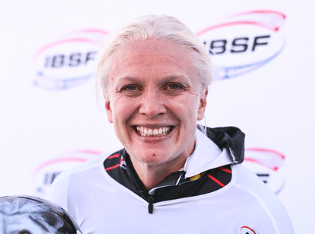
The penultimate round of the 2025/26 Skeleton World Cup season took place on Friday 9 January at the longest track on the calendar in St. Moritz, Switzerland. Widely regarded as the jewel of the sliding calendar and the birthplace of the sport, the event carried even more weight than usual this year as it also doubled up as the European Championships.
by Deen
For the men, this marked a second World Cup race on the same track in three days, following their rescheduled event on Wednesday after the cancellation in Winterberg. During the untelevised Wednesday event, World Champion and defending World Cup champion Matt Weston blitzed the field. Britain’s Weston finished fastest in both runs, setting both a start and track record in run two to top the field by a massive 1.29 seconds. That winning margin is the largest winning margin in a men’s World Cup race for 14 years.
Amedeo Bagnis finished second on his strongest track while Germany’s defending Olympic champion reached the podium for the first time this season a month before the Olympic Games, after being hampered by two consecutive injuries on his leg and calf earlier in the season. This meant going into Friday’s event Weston held a comfortable 150-point lead over Yin Zheng in the overall standings.
Janine Flock’s win in Winterberg gave her a 16 point lead at the top coming into St. Moritz, overtaking Kim Meylemans. Jacqueline Pfeifer came into the weekend in third overall, just 15 points ahead of Czechia’s Anna Fernstädt, while Tabitha Stoecker and reigning Olympic champion Hannah Neise rounded out the top six.

Women’s race – Meylemans dominates with shocks behind
Run 1
The first slider to post a truly competitive time was Britain’s Tabitha Stoecker. She utilised a strong start and top section to claim the lead despite a massive hit exiting the penultimate corner. She finished 0.38 seconds ahead of the early benchmark of Kimberly Bos. Straight after came Pfeifer. The German’s start disadvantage compared to the Brit left her behind throughout most of the course, but using her signature late run speed and impeccable form, she snatched top spot by just 0.09.
World Cup leader Flock followed next but had an uncharacteristically scruffy run, with mistakes in seemingly every corner leaving her a second off the pace and ultimately in 22nd place. Kim Meylemans went off soon after, knowing that Flock’s run opened the door for her to snatch the World Cup lead straight back. Meylemans delivered a scintillating run, joint fastest right off the bat, building on that advantage across the rest of the run with perfect lines and top speeds. Ultimately, Meylemans stopped the clock at 70.78s, a healthy 0.44 seconds up on Pfeifer.
St. Moritz’s status as a natural track often gives an advantage for later, lower ranked sliders in the draw especially in the first race of the day. Kendall Wesenberg was the first to benefit with excellent lower half speed, finishing joint third and just 0.53 back, despite the slowest start in the field. Julia Erlacher went off immediately after. The fastest start in the field in 5.18 carried her through the first half of the track to finish a fabulous second, just 0.40 back and comfortably her best ever World Cup run.
The first run gave us a mixed-up field, with only four top-ten ranked sliders in the top ten after run one, with a current top three and European Championship podium of Meylemans, Erlacher and Pfeifer. Could the likes of Erlacher and Wesenberg remain up in the top five? Could Fernstädt and Flock climb to the top ten after a disastrous run left them in 21st and 22nd respectively?

Run 2
Fernstädt and Flock had slightly better runs, but could only move up to 18th and 20th respectively overall after a disastrous first run. Moving on to the top-ten ranked sliders after run one, the first to put down a run that could challenge for a medal was USA’s Kelly Curtis who was in ninth after run one. Curtis had a consistent run, with few errors leaving her fifth fastest off the start and reaching the second fastest speed at the bottom. This left her with a scintillating new track record of 70.68 to take the provisional lead from Germany’s Susanne Kreher, staking her claim for a medal.
Nicole Silveira of Brazil was next up. A start a tenth of a second slower than Curtis eradicated her first-run advantage, with that velocity leaving her 0.26s back halfway. Silveira used a slightly cleaner middle section to bring the gap down to a tenth and looked like she would sneak ahead. However, a slight skid in the last few corners cost her and she ended up 0.06s behind.
Following her, Mystique Ro, Hallie Clarke and Kendall Wesenberg all had error-filled runs. Clarke ended the closest at 0.40s back while Wesenberg dropped to 17th.
Stoecker was off next and her slight start advantage extended the gap over Curtis from 0.13s to 0.22s early on, but from there the gap reduced. Lines that were slightly off throughout the run brought the gap down little by little, ultimately slipping off at the last time check to end up 0.11s back and in third with three to go. Pfeifer’s usual start disadvantage eradicated her 0.22s advantage immediately, going 0.27s off by halfway, with a tap not helping. From then, she slowly brought the gap down, but similar speeds to Curtis in the latter half of the run meant she only clawed it back to 0.13s. This dropped her to fourth with two athletes to go, guaranteeing Curtis her second ever World Cup medal and Stoecker a first European Championship medal.
Julia Erlacher followed with her run. A great start once again extended her gap to 0.34s. However, a messier run than her first, as well as the lack of a track advantage meant her lead was eradicated. Erlacher dropped like a stone to 14th. Silveira was now guaranteed her first World Cup medal of the season while Pfeifer guaranteed a European Championship medal.
Last to go was Kim Meylemans, with a massive 0.66s advantage. Right from the start Meylemans eked out her lead, with a 5.21s fastest start of the entire second heat. Immediately her gap extended to eight tenths. Top two fastest speeds across the rest of the track extended her lead to a massive 1.11 seconds, absolutely demolishing the field with a 70.23s track record. Meylemans remarked after the run that it was “the best run ever.”
An untouchable Meylemans takes the World Cup gold as well as the European Championship title. Curtis and Silveira rounded off the World Cup podium while Stoecker and Pfeifer were the other European Championship medalists. In the overall standings, Meylemans reclaims the lead by a comfortable 130 points, with a disaster from Flock dropping her from first to third behind Pfeifer. A top 16 finish in Altenberg next week will be enough to give Meylemans her first Crystal Globe trophy for winning the World Cup overall.

Men’s race – Weston wins again to take third gold in three days
Run 1
Yin Zheng of China was the first athlete out of the blocks, and the fourth-place finisher from Wednesday’s race put down a very solid run. A competitive start time of 4.78s combined with a very clean drive down the track put up a solid initial benchmark of 68.72. Straight after came Matt Weston, who dominated Wednesday’s race by over a second.
Weston immediately started 0.01s faster, but a correction and slight tap out of kink one dropped him behind by 0.01s. However, great form throughout the rest of the run meant he reclaimed the lead at the next split, eking out his advantage to 0.19 seconds by the end of the run. Despite leading, this was a much smaller margin than Wednesday’s race and Weston was clearly unhappy with the run afterwards.
The next few sleds could not get within three quarters of a second of Weston until Amedeo Bagnis, Wednesday’s silver medallist and 2023 World Championship silver medallist on the same track, went off. Bagnis started just 0.05s off Weston, with decent lines except a slight flop in the middle of the run meaning the deficit only slightly increased. At the end of the run, Bagnis was comfortably in third, 0.35s off.
The rest of the top ten ranked sliders could not get within 0.65s of Weston until the penultimate slider in that top ten, Jung Seunggi of Korea, went off. Jung started sixth fastest at 0.11s back but his speeds improved steadily at every speed trap after that, reaching the second-fastest speed at the bottom to come in 4th, 0.46s back. Crucially, Jung was two tenths of a second in front of Marcus Wyatt and as it stood would move up to third in the overall skeleton standings.
Reigning Olympic champion Christopher Grotheer went off a few sliders later, his usual start disadvantage of two tenths slower than Weston left him 0.40s back halfway down. However, Grotheer used his prime late run speed, form and lines to stabilise that gap and only end up 0.44s back at the line to snatch that provisional fourth place from Jung.
Twentieth starter Lin Qinwei of China set a mega 4.68 start record but an untidy bottom half left him 0.57s back at the line, finishing tied for sixth with Germany’s Felix Keisinger.
After run one, Weston held a decent lead over Yin and Bagnis. Grotheer sat third among the Europeans while Jung was also not out of medal contention. Behind them, less than half a second covered spots from sixth to 21st.
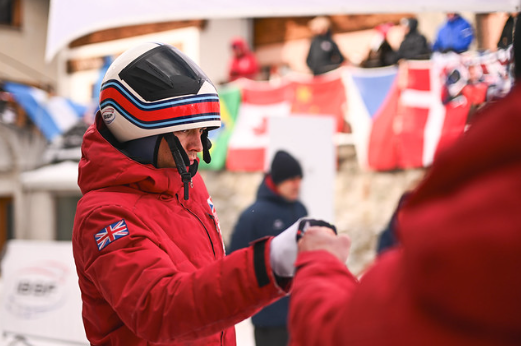
Run 2
The first of the top ten sliders from the first heat to go off was Chen Wenhao of China. Chen had a scintillating run, with a start 0.05-second faster than his first heat and great lines through the course giving him the fastest second heat run so far. Chen’s coach was ecstatic with the run. The next four sliders all fell behind Chen, with Keisinger ending up the closest at just 0.08s back. Chen moved up from tenth to sixth with five to go.
First off was Jung Seunggi of Korea. Jung’s slide was slightly untidier than his first but a 0.27s advantage was too much for Chen to overhaul. Jung held on by 0.11s thanks to great lines and top four speeds at the bottom. The Olympic champion, Grotheer, went off immediately after. A slightly slower start left him initially 0.04s back but a much tidier top section than Jung meant he quickly reclaimed the lead. Despite imperfect lines at the bottom, Grotheer still grabbed the lead by just a tenth of a second. Importantly, this guaranteed Grotheer a medal with only two Europeans left to go.
Bagnis was next off. A faster start doubled his advantage over Grotheer with his lead peaking at two tenths of a second. Bagnis lost a bit to 0.07s thanks to Grotheer’s impeccable first half, but a cleaner bottom extended that gap once again to 0.22s to record the fastest second run so far.
Yin of China recorded the exact same start as Bagnis to maintain his 0.16s advantage. However, a couple of adjustments throughout the track slowly brought that gap down, leaving them dead level at the penultimate time check. Ultimately, Yin just fell behind by 0.07s but still hung on to second.
Weston was the final athlete at the start block, holding a comfortable 0.35-second lead over Bagnis. The Brit slightly outstarted the Italian and from there his gap just continued to increase, his win never looking in doubt. Faultless lines extended that gap to a mammoth 0.91s at the line to take his fifth win of the season.
Matt Weston claims both the World Cup win and European title, Bagnis in second takes World Cup silver and European Championship silver. Yin takes World Cup third while Grotheer takes the European Championship bronze. Elsewhere, Jung of Korea took fifth to move up to third in the overall standings. Weston now leads the overall standings by a huge 175-point margin, just needing 23rd or higher in the Altenberg World Cup finale later this week to take the Crystal Globe.

Mixed Team Event – Surprise results in snowy conditions
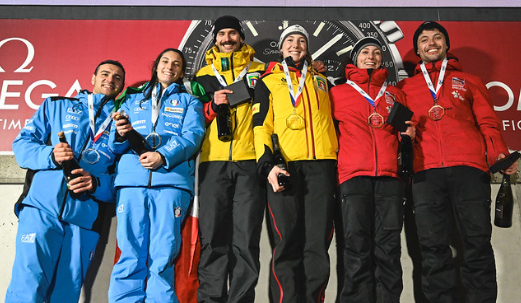
China’s combination of Zhao Dan and Yin Zheng struck gold. Both sliders ended up with the second-fastest performances in their male and female categories to end up with a combined time of 2:26.16.
Germany’s team of Susanne Kreher and Axel Jungk ended up taking Silver and becoming European champions at 0.09 seconds back with two consistent runs. This was despite fielding their second fastest combination based on the individual results.
Italy’s Alessandra Fumagalli and Amedeo Bagnis took third overall and European Championship silver thanks to the fastest run of the race from Bagnis who has been in excellent form this week. They finished 0.29s back with Fumagalli taking her first ever European Championship and World Cup medal.
The second-ranked British team including Great Britain’s third ranked athletes surprisingly finished fourth with the European Championship bronze, thanks in large part to Freya Tarbit performing miles better than in the individual race and recording the fastest female run. This gave both Freya Tarbit and Jacob Salisbury their first ever European Championship medal.
The higher ranked teams came at the end of the startlist but none of the last five or so teams factored due to increasing snow making the track progressively slower. These top teams also had some of their stars missing – Germany 1 were without Grotheer, Austria without Flock and Great Britain 1 without both Weston and Stoecker for various illness and injury reasons.

Results & Standings
Women
| Women | Slider | Country | Time | Gap |
| 1 | Kim Meylemans | Belgium | 2:21.01 | |
| 2 | Kelly Curtis | United States | 2:22.12 | +1.11s |
| 3 | Nicole Silveira | Brazil | 2:22.18 | +1.17s |
| 4 | Tabitha Stoecker | Great Britain | 2:22.23 | +1.22s |
| 5 | Jacqueline Pfeifer | Germany | 2:22.25 | +1.24s |
| 6 | Susanne Kreher | Germany | 2:22.50 | +1.49s |
| 7 | Hallie Clarke | Canada | 2:22.52 | +1.51s |
| 8 | Zhao Dan | China | 2:22.58 | +1.57s |
| 9 | Kimberly Bos | Netherlands | 2:22.70 | +1.69s |
| 10 | Amelia Coltman | Great Britain | 2:22.76 | +1.75s |
Rows in bold indicate non-European athletes
Full results: Here
| Women | Slider | Country | Points | Gap |
| 1 | Kim Meylemans | Belgium | 1243 | |
| 2 | Jacqueline Pfeifer | Germany | 1113 | -130 |
| 3 | Janine Flock | Austria | 1102 | -141 |
| 4 | Tabitha Stoecker | Great Britain | 1060 | -183 |
| 5 | Anna Fernstädt | Czech Republic | 994 | -249 |
| 6 | Susanne Kreher | Germany | 872 | -371 |
| 7 | Hannah Neise | Germany | 858 | -385 |
| 8 | Kimberly Bos | Netherlands | 845 | -398 |
| 9 | Amelia Coltman | Great Britain | 816 | -427 |
| 10 | Nicole Silveira | Brazil | 808 | -435 |
Men
| Men | Slider | Country | Time | Gap |
| 1 | Matt Weston | Great Britain | 2:16.58 | |
| 2 | Amedeo Bagnis | Italy | 2:17.49 | +0.91s |
| 3 | Yin Zheng | China | 2:17.56 | +0.98s |
| 4 | Christopher Grotheer | Germany | 2:17.71 | +1.13s |
| 5 | Jung Seunggi | South Korea | 2:17.81 | +1.23s |
| 6 | Chen Wenhao | China | 2:17.92 | +1.34s |
| 7 | Felix Keisinger | Germany | 2:18.00 | +1.42s |
| 8 | Axel Jungk | Germany | 2:18.02 | +1.44s |
| 9 | Marcus Wyatt | Great Britain | 2:18.21 | +1.63s |
| 10 | Austin Florian | United States | 2:18.43 | +1.85s |
Rows in bold indicate non-European athletes
Full results: Here
| Men | Slider | Country | Points | Gap |
| 1 | Matt Weston | Great Britain | 1335 | |
| 2 | Yin Zheng | China | 1160 | -175 |
| 3 | Jung Seunggi | Korea | 1080 | -255 |
| 4 | Marcus Wyatt | Great Britain | 1051 | -284 |
| 5 | Axel Jungk | Germany | 1042 | -293 |
| 6 | Amedeo Bagnis | Italy | 990 | -345 |
| 7 | Samuel Maier | Austria | 938 | -397 |
| 8 | Chen Wenhao | China | 896 | -439 |
| 9 | Christopher Grotheer | Germany | 838 | -497 |
| 10 | Felix Keisinger | Germany | 832 | -503 |
Mixed Team Event
| Team | Sliders | Country | Time | Gap |
| 1 | Zhao Dan / Yin Zheng | China 1 | 2:26.16 | |
| 2 | Susanne Kreher / Axel Jungk | Germany 2 | 2:26.25 | +0.09s |
| 3 | Alessandra Fumagalli / Amedeo Bagnis | Italy | 2:26.45 | +0.29s |
| 4 | Freya Tarbit / Jacob Salisbury | Great Britain 2 | 2:26.65 | +0.49s |
| 5= | Amelia Coltman / Marcus Wyatt | Great Britain 1 | 2:26.66 | +0.50s |
| 5= | Mystique Ro / Austin Florian | United States 1 | 2:26.66 | +0.50s |
Rows in bold indicate non-European teams
Full results: Here
Next Up: Altenberg!
The Skeleton World Cup season concludes this week in Altenberg, Germany, one of the most difficult tracks on tour. The men’s, women’s and mixed team events all take place on Friday 16 January.

Leave a comment