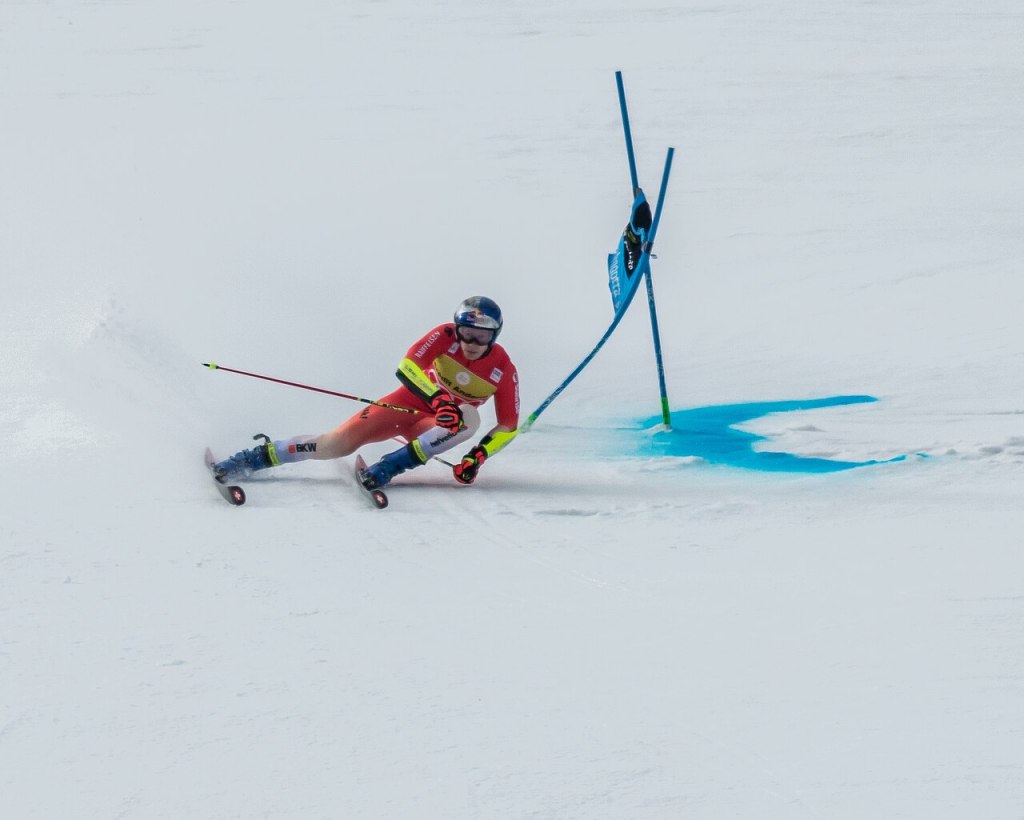
Giovanni Franzoni won the world-famous downhill in Kitzbühel. Marco Odermatt came out on top in another Super-G, while Manuel Feller scored his first win in around two years in the Sunday slalom.
by Maciej Jackiewicz
Friday – Super-G
The ultimate Alpine Ski World Cup weekend in Kitzbühel started off on Friday with the sixth Super-G of the season. The first skier on the course was Nils Allegre, and his 1:09.13 time was enough to put him in the lead for quite a long time. The one to beat Frenchman’s result was Dominik Paris of Italy, who with Bib 6 went 0.27 seconds faster than Allegre. His time was matched by Stefan Rogentin, and they sat ex aequo in the first position. This changed quickly with the run of Stefan Babinsky, who went 0.20 seconds faster than the Italian-Swiss duo, and then Franjo von Allmen who outpaced Babinsky by 0.22 seconds.
It was clear that it would be the duo we have seen fight so many times that would battle for the win – Marco Odermatt and Franjo von Allmen. Odermatt’s run started strong, with him getting a 0.32 advantage over von Allmen at the halfway mark, but his gap quickly disappeared in the lower part of the Streif. On the line, he was able to clinch the win by only 0.03 seconds. At this point the podium was set – it was Marco Odermatt that won, followed by Franjo von Allmen and Stefan Babinsky.
One of the most dramatic moments of the race was the run of Adrian Smiseth Sejersted. The jump in the first part of the course was the place where Sejersted nearly fell but after acrobatics manoeuvres in the air he was able to stay on his skis and ultimately finish in fifth. Quite surprisingly we did not see a lot of non-finishers. Notables one include Simon Jocher, Elian Lehto and Florian Schieder. Two-time Kitzbühel downhill winner Aleksander Aamodt Kilde withdrew before the event with a back injury.
The person that was over the moon after Friday’s runs was Luc Alphand. Both sons of the 1996–97 overall World Cup leader, Nils and Sam, finished well in the points, despite high starting numbers. Nils ended up 13th, while Sam finished the course in 16th. Another result worth mentioning is the 28th position scored by Max Perathoner. The Italian continues his Super-G point-scoring streak, after finishing 29th in Livigno.
In the overall Super-G standings it is still Marco Odermatt leading with a huge 158-point gap over Vincent Kriechmayr in second, as the Austrian finished 7th in Kitzbühel. He is followed by two Austrians – Stefan Babinsky and Raphael Haaser, with the latter finishing just outside of podium in Friday’s competition.
Saturday – Downhill
Arguably the most important event of the whole alpine skiing calendar is the Kitzbühel downhill on the Streif course. A lot of celebrities attend this one race, known for extreme speeds and length. It started off with Mattia Casse, but the first very quick time was came from the Wengen Super-G winner Giovanni Franzoni. He set a very respectable benchmark time of 1:52.31. No one in the first ten could match the Italian’s result, but there were some skiers that came close. Most notably Florian Schieder of Italy set a time 0.67-second slower than the leader.
Twelfth on the course was the huge favourite Marco Odermatt. The Swiss skier never won the Kitzbühel downhill, but his time looked very promising. On the line, a heartbreak awaited the Swiss, as he lost to Franzoni by 0.07 seconds. Franjo von Allmen was next, and he also came very close to beating the Italian, but a mistake in the second part of the run cost him a lot, as he subsequently finished in 16th. The podium at that point was Franzoni, Odermatt and Schieder, and as everyone thought it would not change Maxence Muzaton got a blistering run on the Streif to beat Schieder for third by 0.39 seconds. The top three did not change for the rest of the race.
Fortunately, no dangerous crashes happened, but there were some notable skiers that did not reach the finish line. Daniel Hemetsberger missed a gate, while Nils Alphand and Marco Kohler also did not cross the finish line. There were further disappointments, as in front of his home crowd Stefan Babinsky finished only in 34th, while the three Swiss skiers Stefan Rogentin, Alexis Monney and Justin Murisier were classified in 32nd, 35th and 44th respectively.
The one nation that deserves praise for the downhill is France. Apart from surprising Muzaton’s podium, Nils Allegre finished in fifth. Then, a lot of high-bib French skiers occupied positions in the points – Alban Elezi Cannaferina scored his best World Cup downhill result in 12th with Bib 55, Charles Gamel Seigneur collected his first career World Cup points in 15th with Bib 50 and Matthieu Bailet finished 16th with Bib 52.
In the downhill World Cup standings Marco Odermatt still leads comfortably, with his gap over Franjo von Allmen growing to 165 points. Franzoni sits in third with 216 points, followed by two of his compatriots – Dominik Paris, who finished 7th on the Streif, and Florian Schieder.
Sunday – Slalom
The only technical event of the Kitzbühel weekend was the slalom, held at the Ganslern course. The first skier on it was Loïc Meillard, who set a 50.97 time, that as it turned out was the best time of the first run. Because of that, the fight was now mainly focused on the remaining top three spots. Henrik Kristoffersen, who started third, set a time 0.47 seconds slower than Meillard, and it was enough for him to stay in second until the run of Eduard Hallberg. The young Finn showed great pace on the course and in the end he was 0.12 seconds faster than Kristoffersen. The top three after the first run was Meillard, Hallberg and Kristoffersen, with Manuel Feller and Armand Marchant behind the Norwegian skier by respectively 0.01 and 0.02 seconds.
There were big names that did not finish. Most notably, Wengen winner Atle Lie McGrath did not reach the finish line and could potentially lose his slalom World Cup lead. Furthermore, Steven Amiez crashed and Alex Vinatzer missed the last few gates. But there were some positive surprises as well. Juan del Campo Hernández with Bib 58 scored his first World Cup top 30 this season, after waiting for it since March 2024 and his 17th position in Aspen. Less surprisingly, Fabian Ax Swartz from Sweden got another great result in the slalom, as he finished the first run in 21st.
The course setting for run two seemed more difficult than the first one, as the first two skiers on the course were not able to finish. The first one to cross the line was Billy Major with 1:43.40, but he was quickly outpaced by Albert Popov and Joshua Sturm. The biggest positive of the second run was Fabio Gstrein, who a disappointing 22nd time of the first run, set the fastest time of run two and ultimately finished the race in 11th. His compatriot, Marco Schwarz, after a decent 16th time in run one was not able to reach the finish. It was Lucas Pinheiro Braathen of Brazil that beat Gstrein by 0.73 seconds for the top spot.
Braathen’s lead was short-lived however, as Linus Straßer outpaced the Brazilian by 0.04 seconds. This time was very strong, as good skiers like Clément Noël or Timon Haugan could not match the German’s result. It was Manuel Feller, who after an amazing run, was able to take over the lead by 0.53 seconds over Straßer. And then, there were three skiers at the top. Henrik Kristoffersen disappointed, and ended up in 10th. Next, was Eduard Hallberg, who rode better than the Norwegian, but still could not match Feller’s time, as he finished the course in 5th. Loïc Meillard was the leader after run one, but despite a very good form and skiing he lost out on the win by 0.35 seconds. This was the first win of Feller’s since Palisades Tahoe slalom in February 2024.
Thanks to McGrath’s DNF Lucas Pinheiro Braathen took over the lead in the slalom World Cup. The Norwegian skier lost one more position in the standings, as Clément Noël now outscores him by three points. Then, it’s Timon Haugan, Paco Rassat and Sunday’s leader after the first run Loïc Meillard.
Results
| Session | 1st | 2nd | 3rd | Full results |
| Super-G | Marco Odermatt, 1:08.41 | Franjo von Allmen, +0.03s | Stefan Babinsky, +0.25s | Here |
| Downhill | Giovanni Franzoni, 1:52.31 | Marco Odermatt, +0.07s | Maxence Muzaton, +0.39s | Here |
| Slalom | Manuel Feller, 1:40.60 | Loïc Meillard, +0.35s | Linus Straßer, +0.53s | Here |
What’s next?
There are only two events left before the Winter Olympics in Milano-Cortina. The technical specialists will come back to the slopes in Schladming, with the giant slalom taking place on 27 January and slalom happening a day later. 1 February will see the downhill in Crans-Montana – the last time we will see the top-class alpine skiers before we move to Italy for the most important event of the season.

Leave a comment