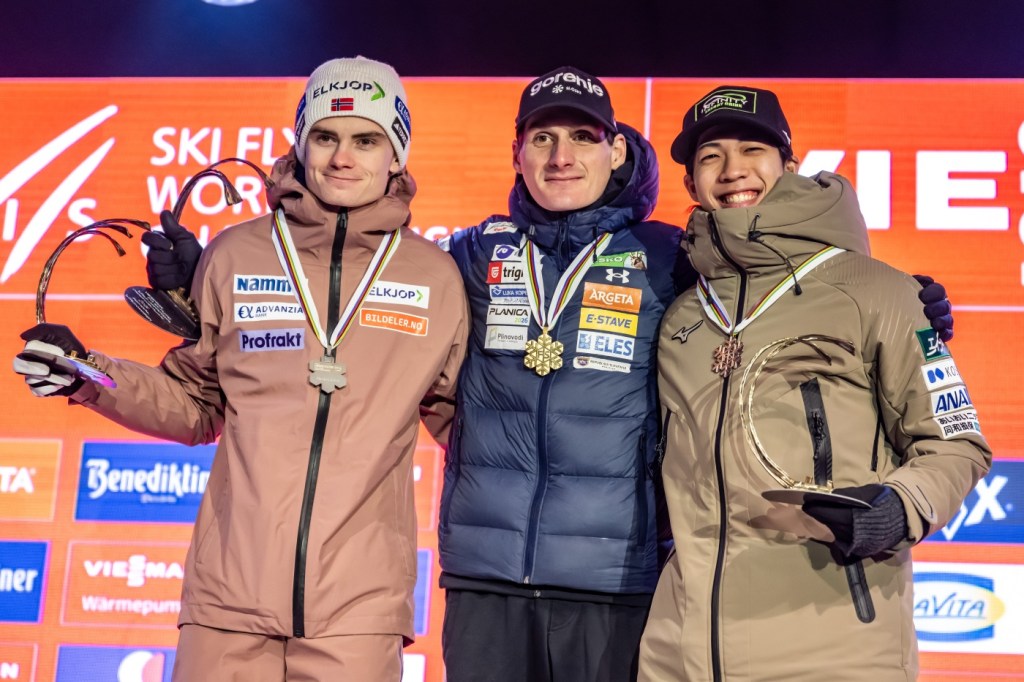
Domen Prevc scored his first Ski Flying World Champion title, exactly ten years after his brother, as he dominated in the Saturday rounds. The team title went to Japan, after a big controversy regarding the individual World Champion Prevc and his skis.
by Maciej Jackiewicz
Saturday – Third and fourth round
After the qualification round on Thursday, and two competition rounds on Friday, the championship picture had already taken shape. Domen Prevc led with a 14-point advantage over Ren Nikaido in second, with Marius Lindvik still in striking distance of the Japanese jumper after consistent flights.
The third round of the individual competition began at 16:30 local time with the jump of Gregor Deschwanden. Him and Jarkko Määttä did not achieve 200 metres, but the third jumper in the round, Felix Hoffmann, flew 202 metres to take the lead. It did not last long as just after him Valentin Foubert jumped 207 metres, before Pius Paschke and Tomofumi Naito landed on 202 and 203.5 metres respectively to move into the first place. The lead changed quickly, as Manuel Fettner and Yevhen Marusiak jumped over 200 metres as well and with 11 jumps done it was the Ukrainian that led. Before the jump of Vladimir Zografski, who was 18th after Friday, the wind got a lot worse, with 1.3 m/s of backwind, thanks to which Piotr Żyła took over the lead despite jumping only 188.5 metres.
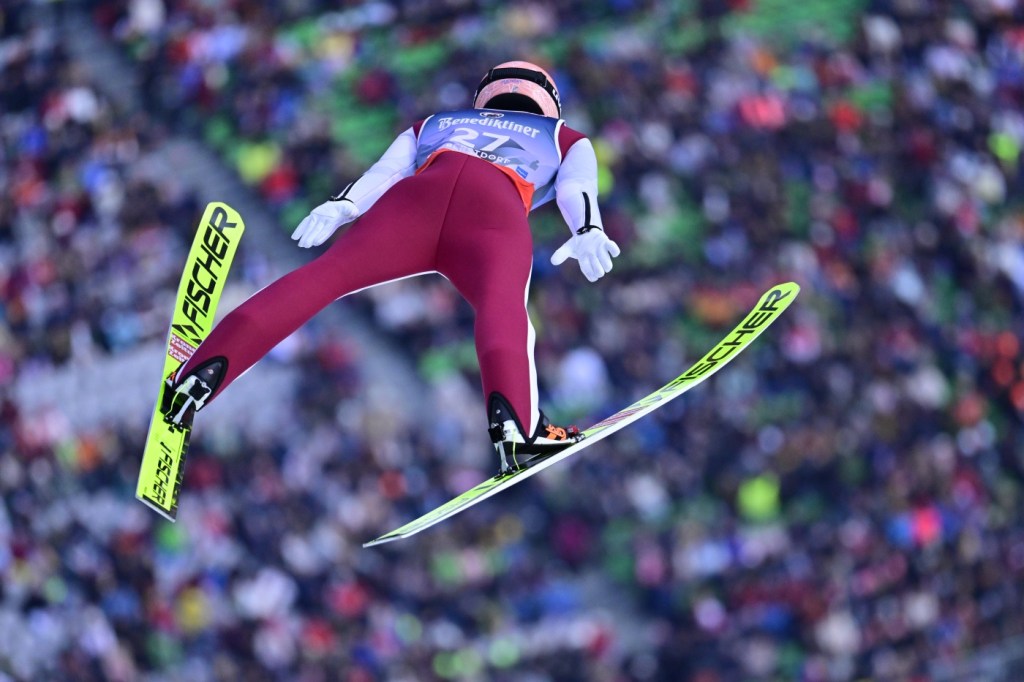
Żyła was quickly overtaken by Kristoffer Eriksen Sundal and Philipp Raimund, but the jumps got longer again, when 10th Stefan Kraft achieved 121 metres. He led for a very long time, and in the end made his way up from 10th after Friday to fifth after the third round. Jan Hörl was the one to outscore Kraft first, as he jumped 211.5m to lead by 13.4 points. But the remaining athletes achieved very good results. First, Marius Lindvik jumped 221 metres to overtake the Austrian, and just after him Ren Nikaido jumps half a metre further. Despite this, the Japanese jumper did not outscore the Norwegian athlete, as the wind conditions were a lot better during the jump of Nikaido. As usual, the gate for Prevc was moved down from gate 24 to gate 20, but in spite of that Prevc got the best distance of the round – 232 metres, to lead by 48.5 points before the final round.
The same two as in the third round began the fourth one, but in 28th after the third round was Daniel Tschofenig, instead of Felix Hoffmann. The Austrian achieved 200 metres, but just after him Hoffmann scored 15 metres more to lead for a longer time. He was pushed off the first place by Valentin Foubert, who outscored the German despite jumping 14.5 metres shorter. Then it was Niko Kytösaho and Manuel Fettner who took over the first position. Yevhen Marusiak, who was sitting in 17th after the three rounds, had big issues in the air and ended up landing on 151.5-metre mark, dropping to 29th in the end. Żyła again, showed a good jump of 212 metres, but he was quickly beaten by two Norwegians – Kristoffer Eriksen Sundal and Benjamin Østvold.
The latter led for a longer time, and thanks to his 221.5-metre jump he made his way into the top 10. The one to take the lead after Østvold was Ryoyu Kobayashi with 219.5 metres. Then, Stephan Embacher bettered the result of Kobayashi by eight metres to attack the podium. It was not enough however, as Marius Lindvik, who was sitting third, achieved a magnificent 231.5-metre result to score a medal. It was a silver medal, as Ren Nikaido jumped only 220 metres and lost to the Norwegian. For Domen Prevc’s jump the gate was moved down from gate 24 to gate 21, but despite that he landed on 222.5-metre mark to win the 2026 Ski Flying World Championships, exactly ten years after his brother Peter won them in Bad Mitterndorf.
Sunday – Team event
The closing act of the 2026 Ski Flying World Championships was the team event, held on Sunday. 10 teams took to the start, with Nikita Devyatkin of Kazakhstan opening the first round. By far the most surprising result in this group was Niko Kytösaho’s 219 metres, that gave Finland second place after the first group. They only lost to Austria, as Stefan Embacher achieved magnificent 233.5 metres, and Japan after 223 metres of Ryoyu Kobayashi. After the second group, for which the gate was moved up from gate 23 to gate 24, the situation in the first place remained unchanged, but Japan moved up to second after the 216-metre effort of Tomofumi Naito.
Group three saw the gate being moved up once again, but it did not change the situation in the top three. Austria led, but Japan’s gap got a lot smaller after an amazing 222.5-metre flight of Naoki Nakamura. Norway was third, and was still in contention to win. But by far the most important situation came in group four, before which the gate was moved down two spots. Before the jump of Marius Lindvik, Domen Prevc’s skis fell down onto the inrun, hitting Lindvik. The competition continued, but Prevc was not able to compete because of the situation. As the first round ended, it was Japan in the lead after 212.5 metres of Ren Nikaido, ahead of Austria and Norway.
In the break between two rounds Slovenia filed a protest to allow Prevc to compete, but it was swiftly rejected as the jury came to the conclusion that the Slovenian athlete put his skis in a wrong place. With the protest not working, Slovenia decided to withdraw from the rest of the event, but they quickly changed their mind and, all in all, the Slovenian quartet appeared in the second round.
The whole second round was focused on the battle for the gold medal between Austria and Japan. After the first group, it was the Alpine country that was on top, after a 217.5-metre jump of Stephan Embacher. By that moment the top three was set, and Norway was nearly certain of the bronze medal, but the top two could switch at any moment. It did not switch, however, after the second group, that jumped from gate 25, as Stefan Kraft outscored Tomofumi Naito by one metre.
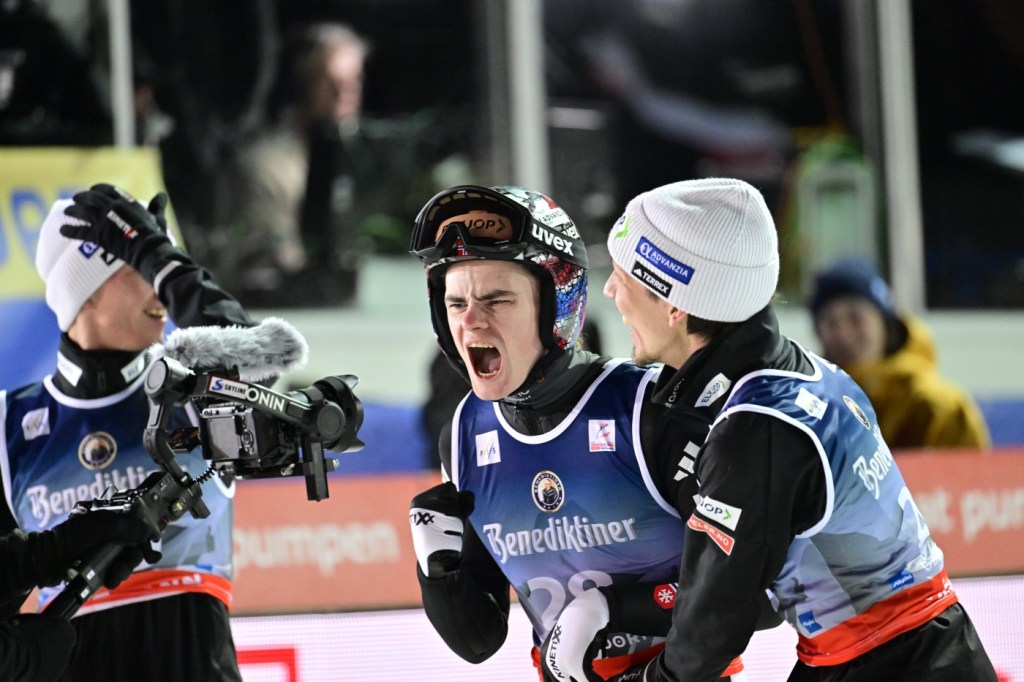
Before group three the gate was moved down to gate 24. It did not stop the athletes to jump far, as Naoki Nakamura achieved the best distance of the second round so far – 224 metres. This, combined with Manuel Fettner’s 214 metres meant that Austria’s gap shrinked to only 0.4 points before the last group. It started off from gate 23, but before the jump of Marius Lindvik it was again moved down to gate 22. Despite this, Lindvik jumped 230 metres to guarantee Norway the bronze medal, and after him Ren Nikaido achieved one metre less to put Japan in the lead. Only one man was left, and it was Jan Hörl. Known for not being able to withstand pressure, the Austrian landed on the 216-metre mark to gift Japan their first-ever Team World Flying Champion title. Behind them, it was Austria and Norway.
Results
| Session | 1st | 2nd | 3rd | Full results |
| Individual | Domen Prevc, 905.4 points | Marius Lindvik, -59.5p | Ren Nikaido, -63.0p | Here |
| Team | Japan, 1569.6 points | Austria, -9.6p | Norway, -85.9p | Here |
What’s next?
There is only one World Cup event left before the Winter Olympics in Milano-Cortina. From 30 January to 1 February the best jumpers in the World will visit the biggest large hill currently in use for official competitions – the Mühlenkopfschanze in Willingen, Germany. As all of the Olympic entries have been announced already, we may not see all of the most important figures in Germany, as they prepare for the most important event of the season at the refurbished Trampolino dal Ben hills in Predazzo, Italy.
Header photo credit: Dominik Berchtold

Leave a comment