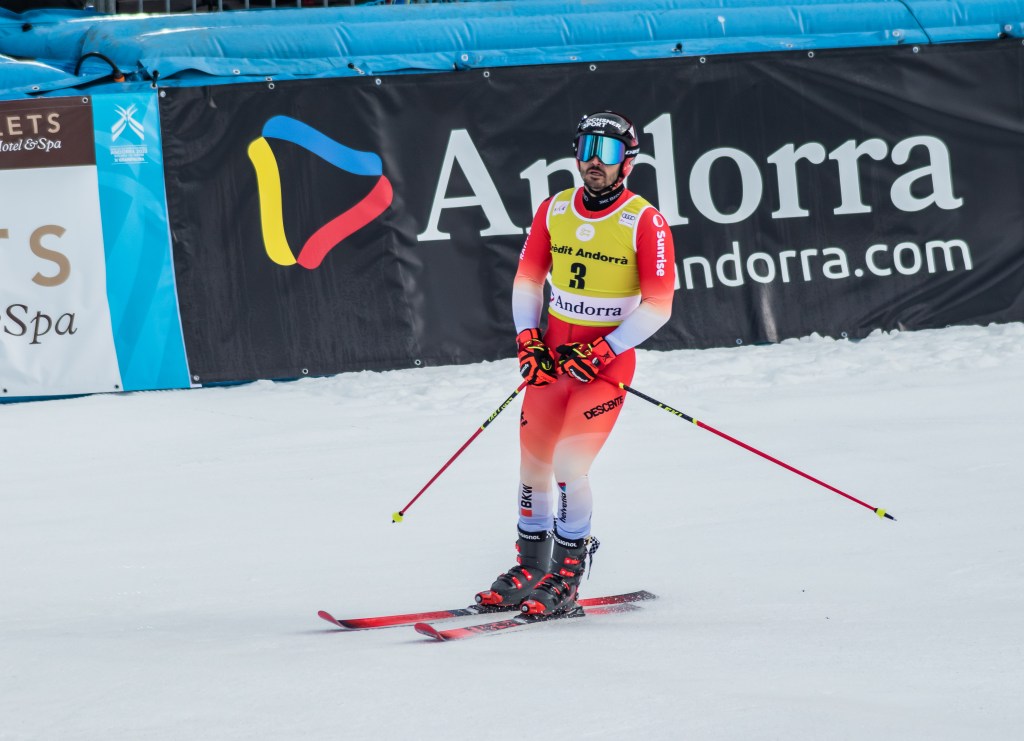
Loïc Meillard won the Tuesday giant slalom in Schladming, with Alban Elezi Cannaferina getting his first World Cup podium. A day later, Henrik Kristoffersen came out on top in the slalom for the first time since March 2025.
by Maciej Jackiewicz
Tuesday – Giant slalom
The classic Nightrace in Schladming started on Tuesday with a giant slalom. From the very beginning the course was very icy, which certainly did not help the skiers on the course. The first one to go was Henrik Kristoffersen, who set an early benchmark of 1:10.39. Just after his run the lead changed twice, as firstly Stefan Brennsteiner beat the Norwegian by 0.78 seconds and subsequently Lucas Pinheiro Braathen outpaced the Austrian by a very impressive 1.40 seconds.
The only one that could battle with the Brazilian was Loïc Meillard, who started just after Pinheiro Braathen, and in the end was just 0.06 slower than him. Marco Schwarz, who started fifth, stayed in fourth for a long time, but quite surprisingly he was beaten by Fabian Gratz by 0.11 seconds, and it was the German that was in third position come the end of the first run.
The iciness of the Planai course caused some of the good skiers to have issues and not finish. The most notable of them include Thomas Tumler, Luca Aerni or Thibaut Favrot. It was also a very difficult day for the Kitzbühel slalom winner Manuel Feller, who did not qualify for the second run with a 44th-best time. Another negative surprise of the first run was Luca de Aliprandini, who ended up in 41st.
Some of the high-bib runners utilised the difficult conditions of the course to make the cut and advance into the second run. Simon Talacci, who started with Bib 60, finished the first run in 24th. Prior to this year’s Schladming giant slalom, he qualified to the second run in the World Cup only once, also on Planai, but he did not finish his second try. In contrast to Talacci, Guerlain Favre from France never qualified for the second run in the World Cup before Tuesday’s GS, as he concluded the Nightrace‘s first run in 27th.
The second run had arguably more difficult conditions than in the first one. It was showcased early on, as the forerunner crashed into the safety nets, which prompted a delay. It started around 20 minutes after originally planned with the run of the double Olympic bronze medalist in giant slalom Alexis Pinturault. He was quickly replaced at the top by Andreas Žampa, as just after the Slovak skier Eduard Hallberg crashed on the jump, perfectly showing the difficult conditions. Later, two skiers quickly took the lead – Jonas Stockinger and Patrick Feurstein. The latter stayed at the front for a longer time.
Feurstein was 25th after the first run, and the one to beat him was Sam Maes with the 18th result. He was faster than Feurstein by 1.68 seconds, and similarly to the Austrian he stayed first for around five skiers. The run of 13th Timon Haugan was the conclusion of Maes’ lead, and the Norwegian stayed in the lead for quite a long time. River Radamus, who was ninth after run one, was not able to finish the run, but the skier that started next – Alban Elezi Cannaferina – got a very good run and was faster than Haugan by 0.73 seconds to attack the podium places.
Skiers from the likes of Marco Odermatt or Anton Grammel struggled to get a good time on the course, and they finished behind the leading Frenchman. Alex Vinatzer of Italy was looking good, but a mistake in the end resulted in him being disqualified. Fabian Gratz, who was third after the first run, did not handle the pressure and ultimately dropped to 11th in the standings. With that, Elezi Cannaferina scored his first World Cup podium. Loïc Meillard was the one to beat the 22-year-old from Lyon, as he outpaced him by 0.90 seconds. Lucas Pinheiro Braathen did not go quick enough to fight with the Swiss skier, and ultimately finished second, 0.73 seconds behind Meillard.
Wednesday – Slalom
The Wednesday slalom started at the same time as Tuesday giant slalom, and the conditions seemed to be similar, although the course was less icy than the day before. The first skier out on the course was Atle Lie McGrath, and as it turned out later on his 53.12 time was enough to secure the top spot after the first run. After McGrath, his compatriot Henrik Kristoffersen commenced and set a time 0.15 seconds than McGrath, to finish the first run in second. Bib 3 was the giant slalom winner Loïc Meillard, who was slower than the leader by 0.44 seconds, and ultimately ended up in third. The first three skiers on the start list were the same three that secured all the top spots come the second run.
The slalom had similar conditions to the GS the day before, so similarly some good skiers struggled on it. Linus Straßer did not finish the course after making mistakes in the last turns. He was joined on the non-finishers list by skiers like Oscar Andreas Sandvik, Kristoffer Jakobsen and Sam Maes. Two Austrian slalom stars Marco Schwarz and Michael Matt struggled as well, as they finished the first run out of the top 30. The only skier from the first 15 of the start list who did not make the cut was Steven Amiez, who ended up in 41st.
Some of the high-bib skiers excelled in the difficult conditions. The American Luke Winters, who started 51st, finished the first run in 25th. Thus, he qualified for the second run in the World Cup for the first time since Aspen in March 2024. Theodor Brækken of Norway qualified for the second run for the first time this season, as he sat in 24th come the end of run one. A lot less surprisingly, Fabian Ax Swartz qualified for the second run with Bib 52 and 21st-best time, but the Swedish skier is already a regular second run skier in the World Cup.
The second run commenced with a run of Benjamin Ritchie. He set a 1:56.60 time, but was swiftly outpaced by Joshua Sturm, whose 0.01-second faster run turned out to be the key for a big advance in the second run. After Sturm, we saw some of the good skiers not finish. Adrian Pertl and Dave Ryding from 27th and 26th respectively did not reach the finish line, as well as Dominik Raschner who ended up in 20th after his first run. The one to beat the leading Austrian was Eirik Hystad Solberg of Norway, whose time was 0.47-second faster than Sturm’s.
Just after Solberg Istok Rodes did not reach the finish, but then Alex Vinatzer completed a good run and put himself in the lead by 0.06 seconds. Next, Johannes Strolz also did not finish, while Tanguy Nef was en route to take the first place, but a costly mistake on the third intermediate point cost him that and he was at that point in third. As the top ten started their runs, it was the tenth Fabio Gstrein that outpaced Vinatzer 0.24 seconds, but the one to really show great pace and battle for the podium was Clément Noël. The Frenchman, who was eighth after the first run, set a time 1.21 seconds faster than Vinatzer.
The next two runners, Armand Marchant and Eduard Hallberg, made mistakes on the course and did not reach the finish. This really opened the door for a podium spot for Noël. Lucas Pinheiro Braathen was next, but his time was 0.99 seconds slower than the Frenchman’s. Then again two skiers in a row did not finish, and they were Paco Rassat and Loïc Meillard. With that, Noël scored his third podium of the season. Henrik Kristoffersen started net, and he was the one to finally beat Noël’s time, by 0.54 seconds. Atle Lie McGrath mission to beat Henrik was difficult, and he did not succeed with a time 0.34 seconds slower. Henrik Kristoffersen won his first World Cup event since Kranjska Gora double in March 2025.
Results
| Session | 1st | 2nd | 3rd | Full results |
| Giant slalom | Loïc Meillard, 2:14.38 | Lucas Pinheiro Braathen, +0.73s | Alban Elezi Cannaferina, +0.90s | Here |
| Slalom | Henrik Kristoffersen, 1:53.80 | Atle Lie McGrath, +0.34s | Clément Noël, +0.54s | Here |
What’s next?
After an intense month the World Cup takes a break, as the Winter Olympics in Milano-Cortina arrive in February. The technical events will take place in Bormio, the home of the famous Stelvio downhill course. The giant slalom specialists will fight for the medals on Valentine’s Day, while the slalom stars will battle for the top three positions two days later. Before all that, on 9 February some of the slalom skiers will take part in the team combined event, alongside their downhill teammates.

Leave a comment